General Research Interests
Most broadly, I am interested in functional morphology and the evolution of biological structures with complex morphology and function. Structural and functional complexity are inherent to biological systems (just think about how many muscles have to work with or against one another to make your arm move). To examine these concepts, I study feeding in vertebrates. While I have previously worked with tadpoles and lizards, I am currently using avian nectarivores as my study system for my dissertation research.
There are two core concepts that are important to my work, morphology and kinematics. "Morphology" is synonymous with the words "body form" or "body shape." There are many ways to study the morphology of organisms. In my dissertation work I study the tongues of avian nectarivores using computed tomography (CT) scanning, which is a non-destructive technique that results in a 3D model. For my master's work, I studied tongue morphology in lizards using dissection and histology. These various techniques allow me to see and measure the relative sizes, as well as the shapes, of different microscopic tongue features across species. "Kinematics" refers to the sequence of events, and duration of those events, within a large motion or cycle. To examine kinematics I use high-speed video cameras, which can film at up to 1000 frames per second. This extremely high frame rate allows me to visualize movements and behaviors that happen so fast they're not visible to the naked eye. Merging information on morphology with information about kinematics allows us to understand how certain structures function during a particular behavior or movement.
Current Research
Dissertation Research (2020-Present): Functional morphology of plant-pollinator interactions in honeyeaters
Nectarivorous birds exhibit diverse interactions with the plants they feed from and pollinate. Several aspects of plant phenotype, including floral morphology, nectar traits, and perching structure, are known to affect feeding efficiency of nectarivorous birds. These effects are important, as net energy gain is the currency birds would use to make foraging decisions, which ultimately shapes ecological interactions and coevolutionary patterns. There has been relatively little work studying how plant traits affect feeding in honeyeaters, the primary avian pollinators of Australian flora. For my dissertation I'm interested in examining how the interaction between honeyeater phenotype and floral phenotype shapes honeyeater feeding efficiency. I'll be investigating this question using a combination of lab-based and field-based projects, which will complement each other by examining the honeyeater-plant interactions at different scales. This information can be used to better understand honeyeater foraging behavior, as well as the ecological and evolutionary dynamics of the honeyeater-plant system. I'm currently in the 2nd year of my dissertation, so stay tuned to see how this project progresses!
|
|
|
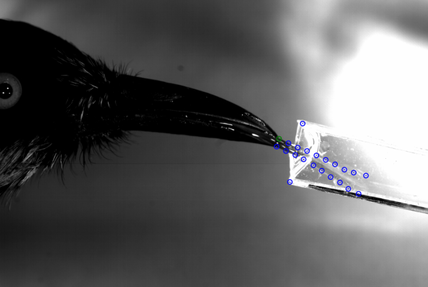
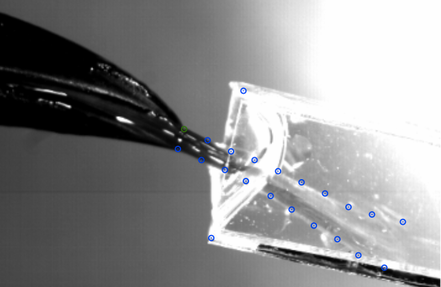
Images: High-speed video analysis of nectar feeding in a New Holland Honeyeater (Phylidonyris novaehollandiae). Left - Full frame image. Right - Close up of tongue.
|
Past Research
Masters Research (2018-2020): Comparative morphology and kinematics of lizard feeding
For my masters work (MSc) in the Schwenk Lab at the University of Connecticut I studied feeding morphology and kinematics in several species of squamate reptiles (squamates = lizards and snakes). I studied the blue-tounged skink (Tiliqua scincoides), the bearded dragon (Pogona vitticeps), the emerald swift (Sceloporus malachiticus) and the common agama (Agama agama). I studied these species because they all use their tongue to capture prey, but T. scincoides evolved the ability to do so independent of the others. By comparing the way lingual prey capture is accomplished kinematically, and determining whether there are morphological correlates of the behavior across these multiple evolutions, we can learn about what traits are required for lingual prey capture and what traits are unique to certain lineages.
|
|
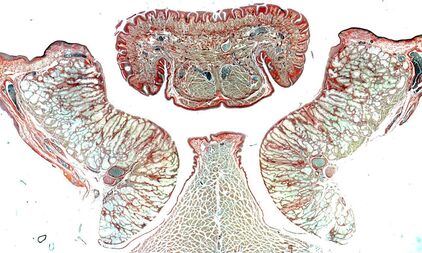
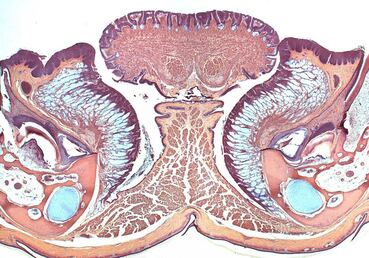
Image: Left-Paraffin histology through the tongue of the blue-tongue skink, Tiliqua scincoides (transverse section). Right-Paraffin histology through the tongue of the prehensile-tailed skink, Corucia zebrata (transverse section). These histological sections allowed me to examine tongue morphology in my masters work.
Undergraduate Assistant Research (2017-2018): Biomechanics of air-breathing in tadpoles
As an undergraduate research assistant in the Schwenk Lab at the University of Connecticut I helped with research on breathing cycles in tadpoles. The tadpoles we studied were those of the gray tree frog (Hyla versicolor), the African clawed frog (Xenopus laevis), the wood frog (Rana sylvatica) and the green frog (Rana clamitans). I specifically worked on kinematic analysis of the breathing cycles of the gray tree frog and African clawed frog. We used high-speed videography (700 frames per second) to record the tadpoles as they approach the water's surface to breathe. Then, we analyze the steps of each breathing cycle using ImageJ software. Once the steps of each cycle are analyzed, we can make comparisons about the structure of the cycles between species, and compare breathing cycles between the tadpole and adult life stages within each species. Tadpoles are an understudied phase in the amphibian life cycle. Analyzing and comparing the breathing cycles in these tadpole species allows us to fill major gaps in our scientific understanding about amphibian development.
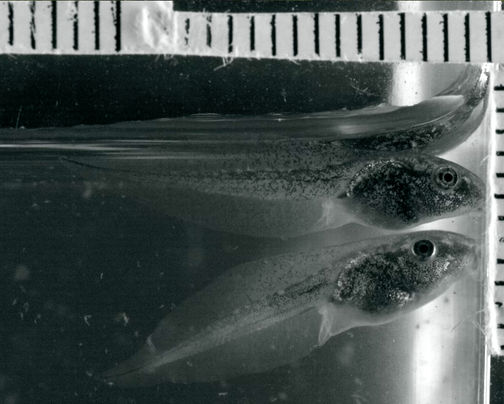
Image: Tadpoles of the gray tree frog, Hyla versicolor, in a filming chamber.
